Unless I see the nail marks in his hands and put my finger where the nails were, and put my hand into his side, I will not believe.’
One of the exciting events of the past week was watching the Artemis II spacecraft fly around the moon and return home safely. I have seen lots of space rocket launches but I am too young to have watched any manned spacecraft travel to the moon – the last one before this week was the Apollo 17 in December 1972.
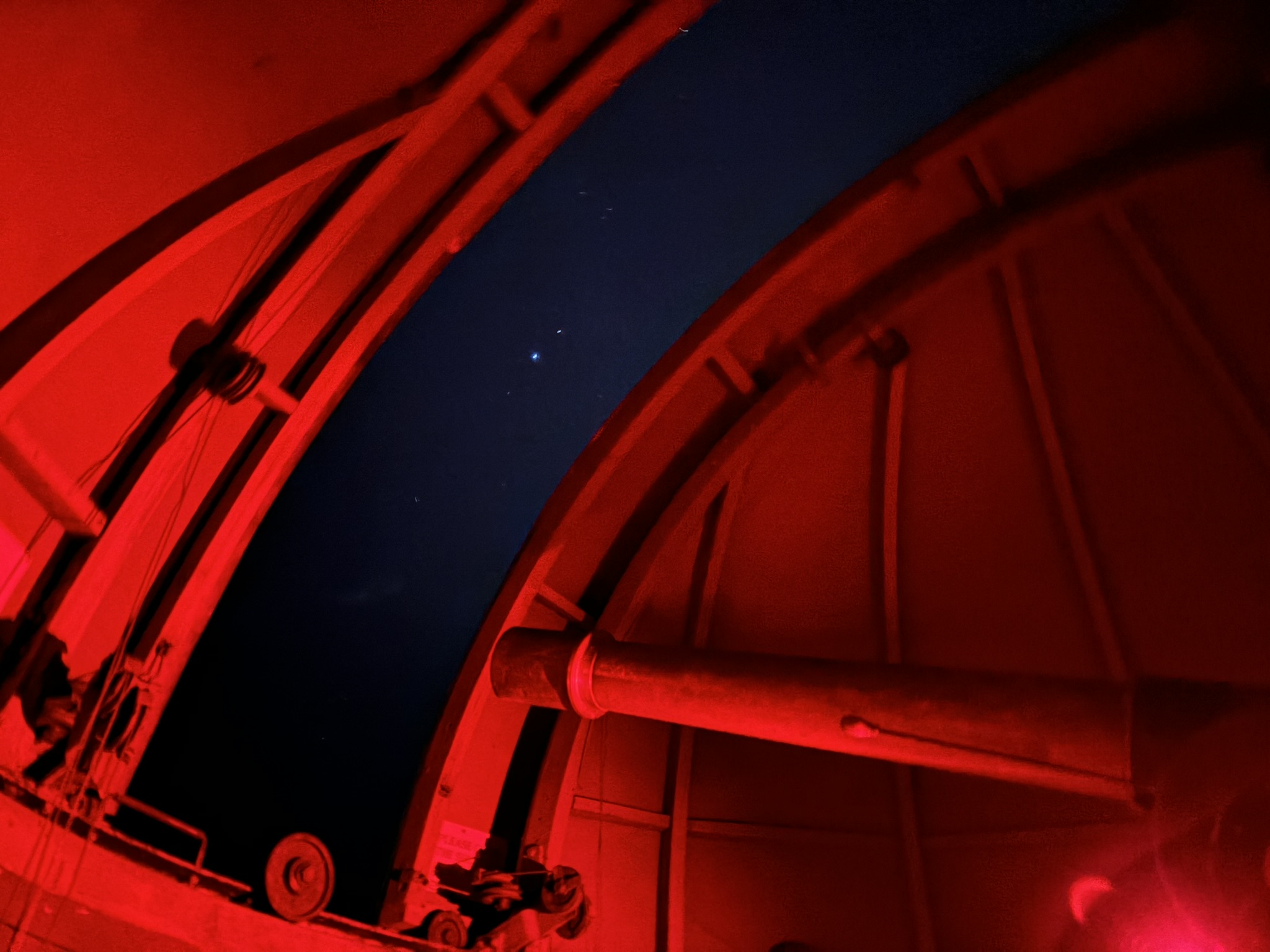
Also, by coincidence, I also went to the Norman Lockyer Observatory in Sidmouth with the Air Cadets. Norman Lockyer was the first person to discover Helium whilst looking at a spectral analysis of the sun using one of his telescopes. He named it in 1868. Other scientists doubted his discovery until Helium was found on earth nearly 30 years later. When they could ‘touch and see’ it for themselves.
Obviously, we didn’t get to see the Artemis spacecraft through the telescopes (it is far too small), but for the first time I did clearly see Neptune and Jupiter including its four largest moons. In January 1610 Galileo Galilei was the first person to see the moons of Jupiter and over many observations he saw that they circled the planet which led him to agree with Copernicus that the planets including the earth orbited the sun. As I am sure you are aware this got him in trouble with the Catholic Church.
This week’s Bible passage is one of my favourite passages – we see the honesty and integrity of Thomas. Confronted by the other disciples telling him they had seen Jesus raised form the dead, he resolutely states that ‘Unless I see the nail marks in his hands and put my finger where the nails were, and put my hand into his side, I will not believe.’ Thomas is often mocked as ‘Doubting Thomas’ as if he was foolish not to believe that Jesus had been raised from the dead. Of course, we can fool ourselves into thinking that we are so much wiser and more sensible and that we would have believed straight away!
We often think of doubt as being a negative attitude, but sometimes it is right and necessary to doubt. We don’t believe every student that says ‘the dog has eaten their homework’ or believe everything everyone tells us at face value. It is right for us to sometimes be sceptical, until we have investigated a story or a situation fully. There would not be any science without doubt, study and investigation – it is what drives researchers and scientists and is a God given ability to challenge and learn and grow.
In one session of our Lent course many of us shared how we first came to believe in God, in Jesus, in the Holy Spirit. For some this was a gradual change, for others they couldn’t put a time on it at all – they had always believed, and for others there was a definite moment of doubt which was turned to faith by what can really only be explained as a supernatural intervention.
The author CS Lewis and Lee Strobel the journalist are two of many who were so convinced that the story of the resurrection was false that they set out to prove it was not true, only for their doubts to be turned to faith as they were confronted with the irrefutable evidence. Their strength of belief was then so strong they were compelled to write, and thereby influence millions of others…
In the book of Hebrews, the author (probably Paul) wrote: ‘Now faith is being sure of what we hope for and certain of what we do not see.’ Hebrews 11:1 God turns our doubts into stronger faith.
In our gospel today the other disciples are not actually certain about Jesus’ resurrection either. It’s not until he speaks ‘peace’ to them and breaths on them his Holy Spirit that they fully believe. It is his Holy Spirit that secures their faith. It is the Holy Spirit who cements our faith too.
It was being filled with the Holy Spirit which not only empowered the disciples’ faith, but birthed the church at Pentecost. Thomas – the one who knew what he believed – was probably the disciple who travelled the furthest preaching the good news of Jesus’ life, death and resurrection. He ministered all the way out to India – some 4000 miles from Jerusalem.
There have been lots of posts on social media doubting the moon voyage and pointing to conspiracy theories, but I wonder how many more will now believe what God has made man capable of through his gift of science? Now that they have witnessed this event for themselves?
I wonder too whether Thomas did actually put his fingers in the holes in Jesus’ hands and feet? Or was the fact that Jesus spoke the truth to Thomas face to face, and offered up himself as a sign enough on its own to satisfy Thomas?
Remember it is the Holy Spirit who causes everyone to believe and to make us certain of what we do not see.
So let God breathe his Holy Spirit on you today and strengthen your faith. We can all go out and proclaim the truth and marvel in God’s grace as he answers our doubts and strengthens our belief!


 Messenger